An essay from a forthcoming book
Funding Innovation or Funding the System?
Britain has built an elaborate system to help good ideas succeed. We need a clearer account of what it costs, what it achieves and what the people doing the work actually need.
A grant has been awarded. A new company has been formed. The announcement is out, the photograph has been taken and the project has joined a list of success stories.
There may be a great deal to celebrate. We still need to know what happens next.
Will somebody use the invention? Will a customer pay for it? Can the team deliver it, support it and keep going? Has public support made something possible that would otherwise have remained out of reach? Those questions can take years to answer. They are also the reason the early milestones matter.
I have spent four decades building, financing, chairing and advising technology and creative businesses. The distance between a convincing proposal and something people want to use is familiar territory. Good advice, patient finance and specialist expertise can change the outcome. So can time to get on with the work.
Funding Innovation or Funding the System? asks how well we distinguish those contributions from the cost of organising, describing and repeatedly assessing them. The answer matters to anyone who pays for public research, works inside it or hopes to turn an idea into something useful.
The announcement is a beginning
Universities produce research that may become a product, a treatment, a manufacturing process or an improvement in a public service. Creating a company is one possible route. An existing business might be better placed to license the invention. A collaboration might bring it into use more quickly. Sometimes the most valuable result will be skilled people carrying knowledge into other organisations.
A spinout is a route, not a result.
That distinction changes the questions we ask. The number of companies formed tells us something about activity. Their later customers, products, failures and achievements tell us much more about what followed. Money raised gives a company resources; what it does with them determines whether the promise begins to hold.
Research needs room for uncertainty. A scientific discovery may have value long before anybody can sell a product based on it. Immediate profit would be a poor universal test. A programme set up to help companies reach customers, however, should be able to explain how its work moves them towards that purpose.
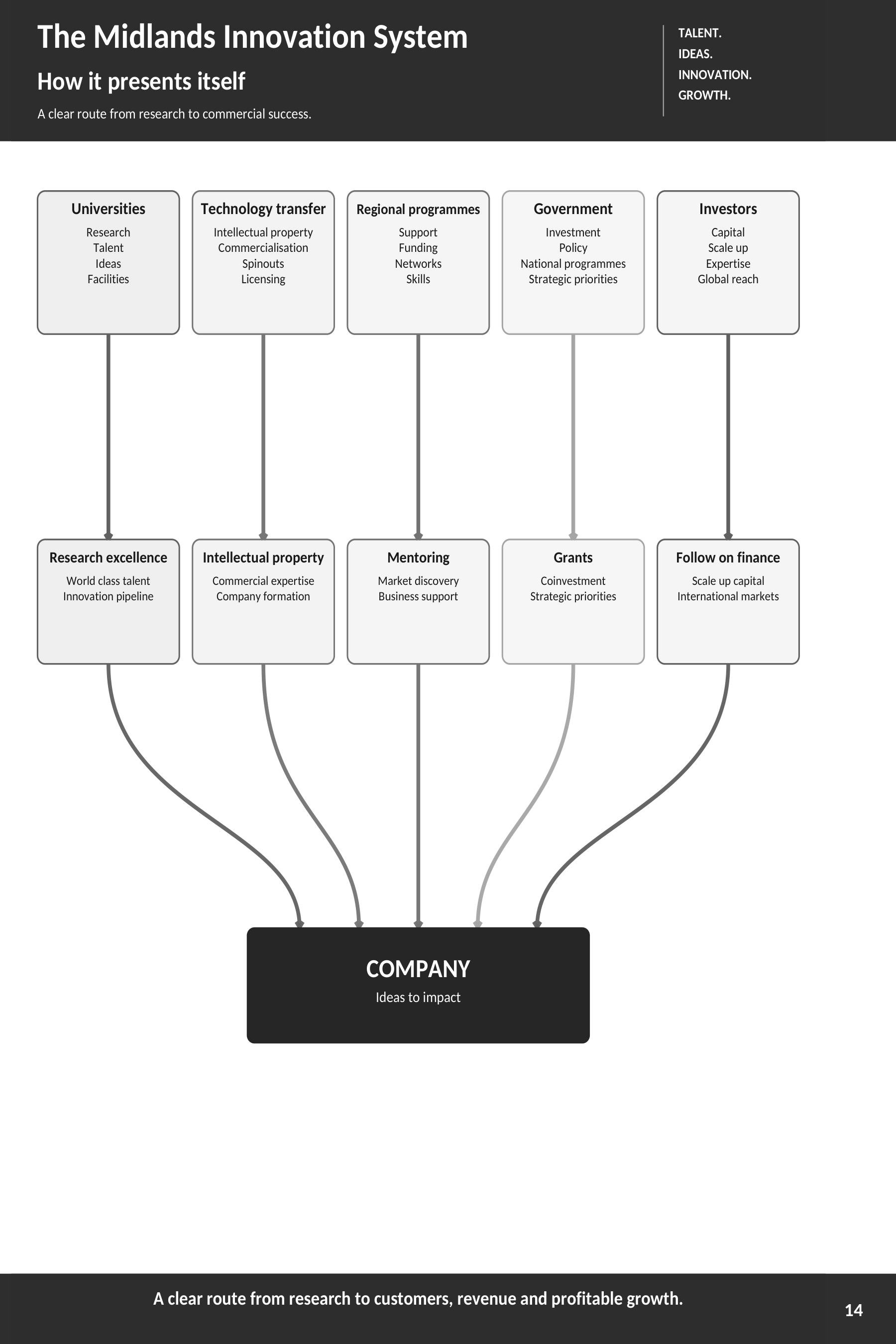
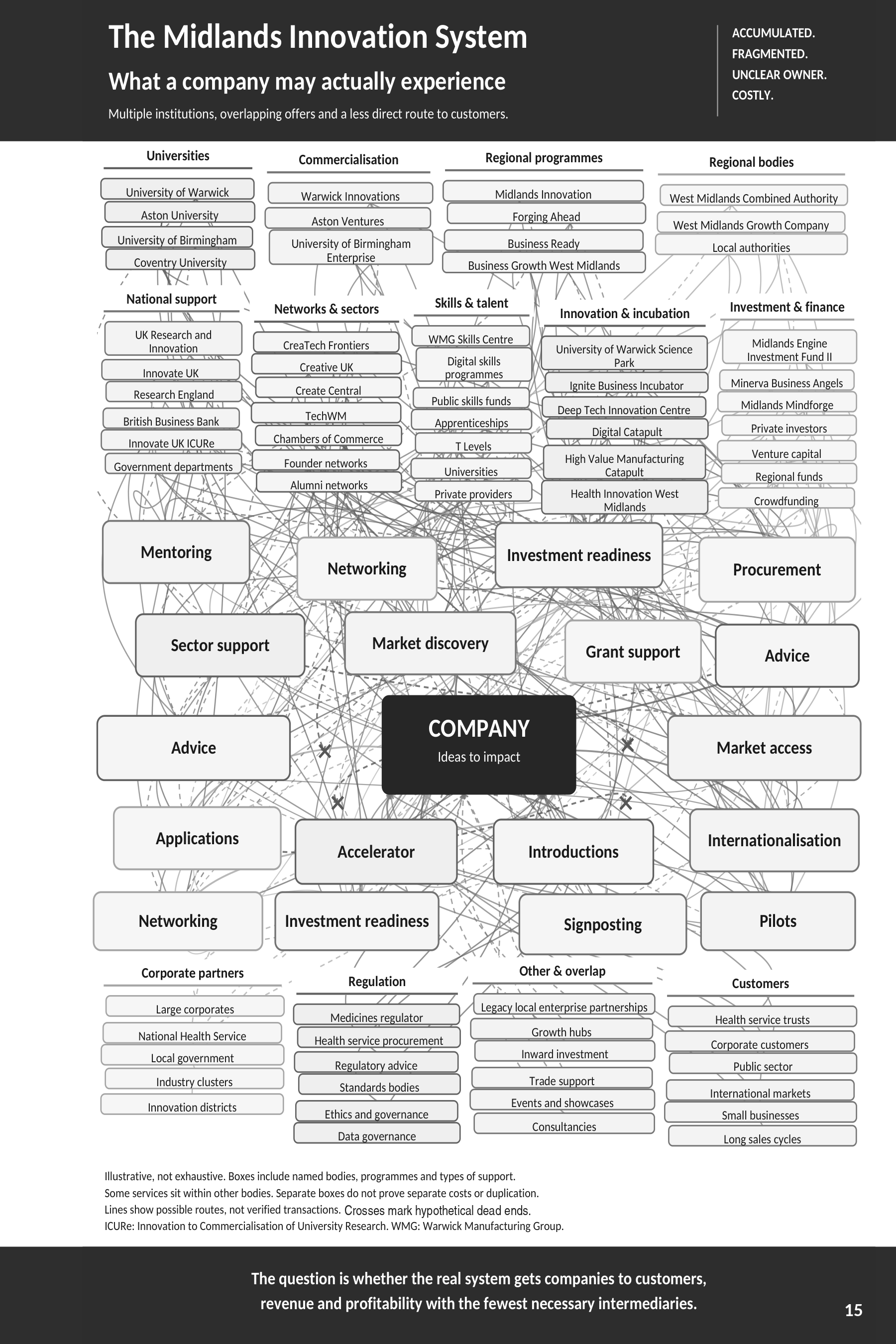
Who follows the whole journey?
A young business may meet several publicly supported organisations. Each has a remit, an application process and something it can offer. One supplies technical help, another finance, another advice. Several may later feature the business in their accounts of what they achieved.
They may all have made a useful contribution. To understand the combined result, we need to follow the business through the whole journey. What did each intervention change? What did it cost? How much time did the company spend applying, explaining itself and reporting? Are different bodies claiming the same improvement?
This concern has an independent history. The National Audit Office's 2020 examination of business support found weaknesses in the design and evaluation of its sample of ten schemes. Most lacked measurable objectives at the outset or adequate evidence of their impact. It also described a wider landscape that had grown piecemeal. That was a defined historical review, not a verdict on every programme operating today. [1]
Reform is already being discussed inside the system. UK Research and Innovation's October 2026 announcement identifies removing duplication, combining professional services and improving commercial awareness among its priorities. It also describes a new service, Velocity, intended to provide more sustained support for businesses. These are commitments to examine as they are put into practice. [2]
A useful test of any reform is what becomes easier for the researcher or company. Which repeated task disappears? Which decision improves? What capability is strengthened? A new name or a simpler front door will only take us so far if the work behind it remains just as complicated.
What would the next pound buy?
The argument becomes more practical when we consider an alternative use of the same resources. A laboratory may need access to a scarce specialist. A small company may need a commercial operator who can work alongside its founders and take responsibility for delivery. A researcher may need the time and financial breathing room to find out whether a customer exists.
A student struggling to finish a course may need help with living costs. The eventual contribution of that person's skills belongs in our thinking about innovation too. Supporting people deserves a fair comparison with supporting the organisations around them. Every option still needs evidence about what it changes.
Relevant experience matters when choosing who can help. Advice about patents, regulation, pricing and cash requires different knowledge. A founder should be able to understand what an adviser brings, which decisions they can influence and what useful work will follow. Attendance at a session is a limited measure of that contribution.
The same care is needed when discussing savings. A payment that genuinely ends may release cash. Spending moved to a better purpose remains spending. Hours returned to a researcher or a company can be valuable without becoming money available in the Treasury. Putting those outcomes into one total would make an arresting headline and a misleading account.
The large annual savings figures discussed during this project are questions for investigation. No audited national total of avoidable expenditure has been established here. A worthwhile review must be free to find a smaller saving, a larger one, or a stronger case for reinvestment. Its conclusion should come from the work.
An investigation that leads to decisions
I propose a time-limited, independent examination with the authority to follow functions, costs and company journeys across institutional boundaries. It should publish what each function is for, what it costs in full, the evidence for keeping it and the practical alternatives.
Some conclusions should protect or strengthen existing work. Technical facilities, scientific expertise, useful finance and capable commercial practitioners are hard to replace. Similar descriptions do not prove that two organisations are doing the same paid work. Different sectors and regions can need different support.
Other conclusions may justify combining services, changing how they are delivered or stopping them. Those decisions need to account for replacement costs and the disruption caused by change. The investigation should sit within existing accountable arrangements, publish its decisions and reach an end.
The book develops the case for that examination. It asks why we place so much emphasis on forming spinouts, how the surrounding institutions accumulated, what relevant commercial competence looks like and how we should judge the results. It examines positive evidence as well as gaps. Its purpose is to make the investigation necessary and useful, rather than announce its findings in advance.
Britain has people with ideas worth backing and institutions capable of helping them. The public should be able to see how the money, expertise and effort fit together. The people doing the work should be able to tell us when support changes their prospects and when it gets in their way.
The next announcement will bring another promise of growth. I want us to be better equipped to follow that promise beyond the photograph.